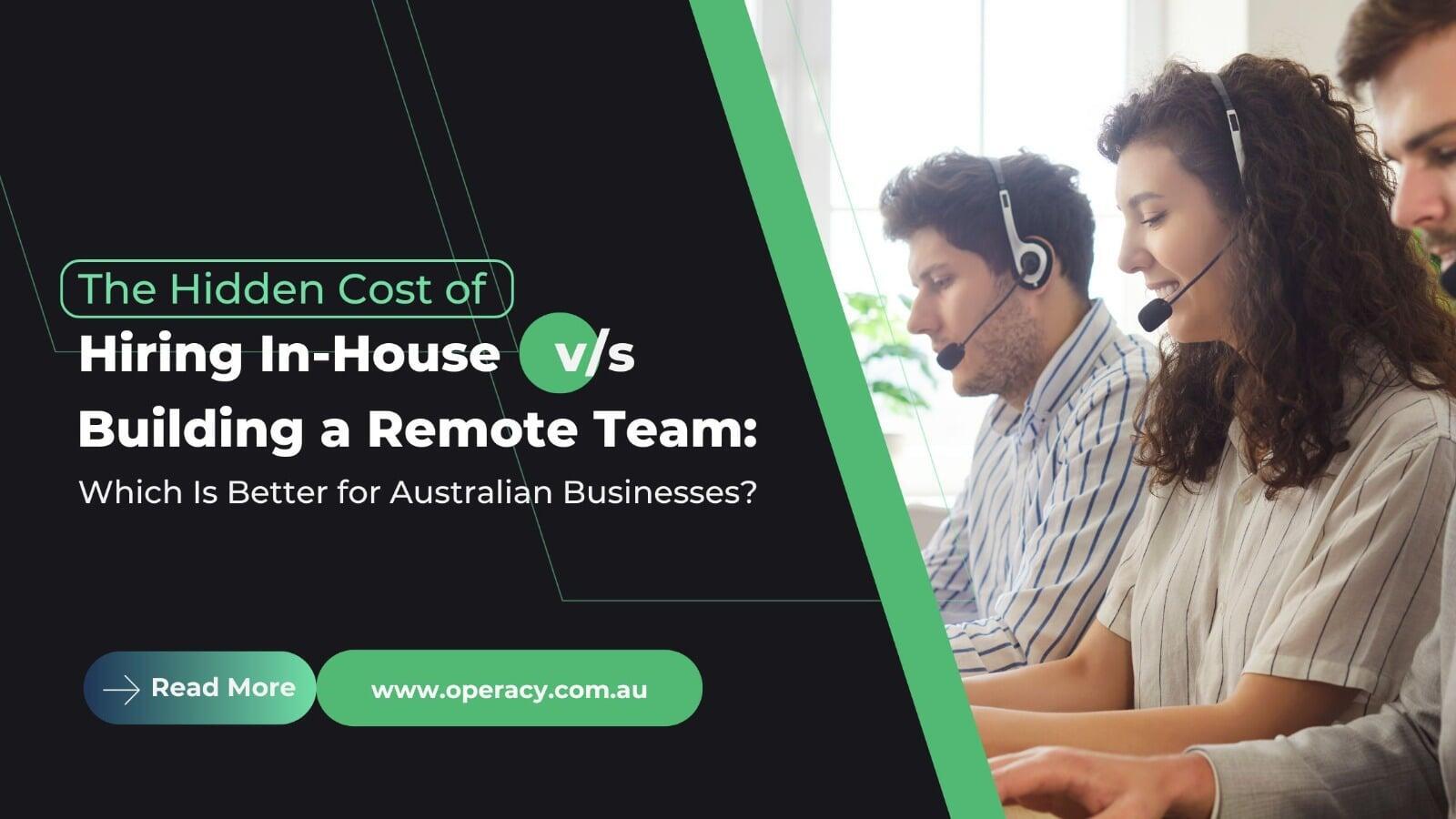
For many Australian businesses, growth brings an exciting challenge—expanding the team. But with rising wages, increasing operational costs, and an increasingly competitive hiring market, business owners are asking an important question: Is traditional hiring still the best option?
While employing in-house staff has long been the standard approach, more organisations are now exploring remote teams as a practical alternative. Supported by a reliable Australian staffing agency, businesses can access skilled professionals without the financial and operational burden that often comes with expanding an in-house workforce.
The decision is no longer simply about where employees work. It's about choosing a workforce model that supports long-term growth, flexibility, and profitability.
Understanding the True Cost of In-House Hiring
Hiring an employee involves much more than offering a salary. Many business owners underestimate the additional expenses that quickly add up over time.
Recruitment advertising, onboarding, training, office space, equipment, software licences, employee benefits, payroll management, insurance, and ongoing professional development all contribute to the total cost of employment. If a new hire leaves within a short period, the recruitment process begins again, creating even more expense and lost productivity.
Beyond financial costs, managers often invest significant time interviewing candidates, supervising new employees, and handling administrative responsibilities associated with maintaining an internal workforce.
These hidden costs can place considerable pressure on growing businesses, particularly small and medium-sized enterprises operating with limited resources.
The Rise of Remote Teams
Remote work has evolved from being a temporary workplace solution into a permanent business strategy. Thanks to cloud technology, collaboration platforms, and secure communication tools, businesses can now work seamlessly with professionals located anywhere.
Rather than being limited by geography, companies can recruit talent based on skills, experience, and cultural fit.
This shift has allowed businesses to become more agile while reducing many of the expenses associated with traditional hiring.
Why Businesses Are Choosing an Australian Staffing Agency
Building a remote team independently can be time-consuming if businesses don't have established recruitment processes.
Working with an experienced Australian staffing agency simplifies the process by providing access to pre-screened professionals who are ready to integrate into existing operations. Staffing agencies understand business requirements, assess candidates thoroughly, and help organisations find talent that matches both technical skills and company culture.
This significantly reduces recruitment time while improving hiring quality, allowing businesses to focus on growth rather than recruitment administration.
The Value of Virtual Assistant Services Australia
Not every task within a business requires a full-time in-house employee. Many repetitive but essential responsibilities can be handled efficiently through virtual assistant services Australia.
Virtual assistants commonly support businesses by managing:
Administrative tasks
Calendar and email management
Customer support
Data entry
CRM updates
Social media scheduling
Research
Appointment coordination
Document preparation
Delegating these responsibilities frees business owners and internal teams to concentrate on higher-value activities such as sales, client relationships, strategic planning, and business development.
Rather than replacing employees, virtual assistants often complement existing teams by improving productivity and reducing workload.
Cost Comparison: In-House vs Remote Teams
When comparing both workforce models, the financial differences become clear.
An in-house employee requires office infrastructure, utilities, equipment, recruitment expenses, employee entitlements, and long-term commitments.
A remote professional, on the other hand, often requires only the tools necessary to perform their role. Businesses avoid many facility-related expenses while still benefiting from experienced professionals who deliver measurable results.
The savings generated through remote staffing can be reinvested into marketing, technology, product development, or customer experience—areas that directly contribute to business growth.
Flexibility That Supports Growth
Business demands constantly change. Seasonal workloads, new projects, and expansion opportunities require businesses to adapt quickly.
Traditional hiring can be slow, involving lengthy recruitment cycles and contractual commitments.
Remote teams offer far greater flexibility. Businesses can scale resources up or down based on workload without carrying unnecessary overheads during quieter periods.
This flexibility is particularly valuable for growing businesses that need to remain responsive while carefully managing operational costs.
Productivity Is About Results, Not Location
One common misconception is that employees are more productive simply because they work in an office.
In reality, productivity depends on clear communication, measurable goals, effective leadership, and well-defined processes.
Modern collaboration tools allow remote professionals to participate in meetings, manage projects, share documents, and communicate with colleagues in real time.
Many businesses have found that remote professionals deliver consistently high performance because work is measured by outcomes rather than hours spent at a desk.
Which Model Is Right for Your Business?
The answer isn't always choosing one over the other.
Many successful Australian businesses now operate using hybrid workforce models that combine in-house employees with remote professionals.
Core leadership roles may remain internal, while administrative support, customer service, marketing, bookkeeping, project coordination, and specialised technical roles are handled remotely.
This balanced approach enables businesses to maintain operational control while reducing costs and improving scalability.
Final Thoughts
Hiring decisions have a lasting impact on business performance. While traditional employment continues to play an important role, growing organisations are increasingly recognising the advantages of building flexible remote teams.
Partnering with an experienced Australian staffing agency gives businesses access to skilled professionals while reducing recruitment complexity and operating costs. At the same time, virtual assistant services Australia provide practical support that allows business owners to focus on strategic growth instead of daily administrative tasks.
For Australian businesses looking to remain competitive in an evolving marketplace, the question is no longer whether remote staffing works. The real question is how quickly organisations can adopt smarter workforce strategies that support sustainable growth, improve efficiency, and position their business for long-term success.